Renovation Works Contract: What to Include and How to Accept the Work
Under Civil Code Article 629, a renovation contract is a works contract (contract for work). The crew completes the agreed work, and you pay the agreed fee.
The contract must state the work scope with an attached estimate, who buys materials, pricing rules, and stage-linked payments. The contract must also cover deadlines, acceptance rules, and warranty terms.
This document is the final step in planning your renovation.

On this page
- What Should a Renovation Contract Include?
- How to Pay in Stages and What to Check Before Paying
- Do You Need a Written Contract With Your Crew?
- How Do You Inspect and Accept the Work?
- What Type of Contract Is a Renovation Contract Under Georgian Law?
- Downloadable Contract Checklist
- Before You Sign the Contract
What Should a Renovation Contract Include?
A renovation contract must put every core term in writing so the work runs without misunderstandings.
How to Pay in Stages and What to Check Before Paying
To pay in stages, write every payment and the matching work stage into the contract upfront. Without a staged payment clause, the law says the fee is paid after the whole job finishes (Article 648).
Pay for each stage only after you inspect and accept the completed work. For the full sequence of works, see our renovation stages guide.
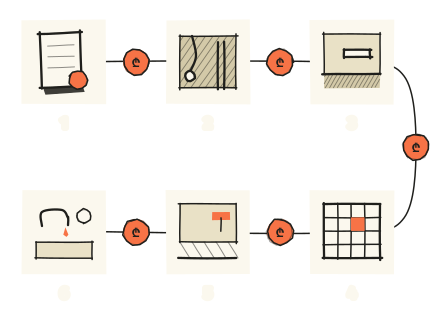
| Stage | What Must Be Finished | What to Check Before Paying |
|---|---|---|
| Signing the contract and advance | The contract is signed with the attached estimate | The advance is a fixed share written in the contract, no more than about a quarter of the price, and you have a written receipt for every payment |
| Demolition (strip-out), partitions, wiring, and pipes | Cables and pipes are in place before walls are closed up | Photos of every wall and floor showing wiring runs are taken before plaster covers them |
| Plastering and floor screed | Walls are plastered and the floor screed is poured | Walls, corners, and floors are flat and straight when checked with a long spirit level |
| Wall tiles and plasterboard (drywall) | Waterproofing is done in wet points (plumbing points), wall tiles are laid, and plasterboard partitions and ceilings are fixed | Waterproofing went on before the tiles, grout lines are straight, and tiles do not sound hollow when tapped |
| Painting and decorating and flooring | Walls and ceilings are painted, and flooring and doors are fitted | No streaks or patches show under angled light, and doors open and close freely |
| Plumbing fixtures, lighting, cleaning, and handover | Plumbing fixtures and lights are fitted, the flat is cleaned, and rubbish is removed | The full checklist below is verified, and the final balance is paid after defects in the handover report are fixed |
Who Buys the Materials, and Why Put It in Writing?
Who buys the materials decides legal liability (Article 646). A crew using its own materials is responsible for poor quality.
The crew answers for misuse, accounts for usage, and returns leftovers if you supply the materials.
The crew must warn you in time if your supplied material is poor or unfit (Article 647). The same duty applies if your instructions would weaken the work.
Ask for receipts whenever the crew buys materials. Get the required quantities from the crew in writing beforehand if you buy the materials yourself.
Can the Price Go Up During the Renovation?
The renovation price cannot substantially exceed an approximate estimate unless the overrun could not be foreseen in advance (Article 631). Otherwise, the crew can claim only the agreed fee.
The crew must notify you immediately of any such increase. You can then cancel the contract and pay for completed work according to the approximate estimate (Article 631).
Put any extra work and its price into a written contract addendum before that work begins.
Do You Need a Written Contract With Your Crew?
A written contract is not required by law, and a verbal agreement is still a valid contract (Articles 68 and 69). However, some terms are valid only in writing, and verbal deals are hard to prove in a dispute.
| Issue | Verbal Agreement | Written Contract |
|---|---|---|
| Price and scope of work | Hard to prove what work and what price were agreed | Everything shows in the estimate attached to the contract |
| Staged payments | Hard to prove, and by law the fee is paid after the job finishes (Article 648) | Each payment is tied to a specific stage |
| Penalty for delay | Void, because a penalty clause requires written form (Article 418) | Valid, though a court may reduce an excessively high penalty (Article 420) |
| Defects | Your Civil Code rights are the same, but proving what was agreed is hard | Backed by the contract and a signed defects list |
How Do You Inspect and Accept the Work?
You accept the work in stages and at the end of the renovation, checking the following points each time.
The same inspection logic applies during apartment handover from the developer.
What Is a Handover Report (Acceptance Act)?
A handover report (acceptance act) is the document you and the contractor sign when accepting a stage or the whole job. The report records the completed work and every defect found, along with the repair deadline.
Write every fault you notice into the report:
- You lose your rights over that fault if you know about a defect and accept the work without raising a claim (Article 652).
- You must accept completed work and pay the fee upon acceptance (Article 649). The work counts as accepted if you do not accept it within the deadline set by the crew. Reply on time with a written defects list.
- The time limit for defect claims starts from the day the whole job is accepted when you accept work in parts (Article 656).
What Should You Do If You Find a Defect After Handover?
You can demand a fix if you find a defect after handover (Article 642). The crew chooses whether to repair the fault or redo the work and covers all necessary transport, labour, and material costs.
When your deadline passes without results:
- You can fix the fault yourself and claim compensation for the costs (Article 643).
- You can reduce the fee by the amount the defect lowered the work’s value (Article 645).
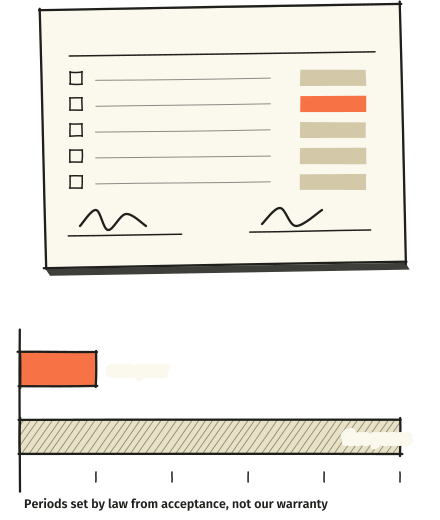
You can bring a defect claim within one year of accepting the work (Article 655). For claims related to a building structure, the limit is five years.
A warranty period applies when the crew has taken on that obligation (Article 653). That is why you must write the warranty into your contract.
What Type of Contract Is a Renovation Contract Under Georgian Law?
By law, a renovation agreement is a works contract (contract for work) under Article 629. In a works contract, you are the client and the crew is the contractor.
The table below sets out the Civil Code rules that matter most for an apartment renovation.
| Issue | What the Civil Code Says | Article |
|---|---|---|
| Fee for preparing an estimate | Preparing an estimate for a contract is not paid unless the parties agreed otherwise. | 629 |
| Damage to your property | The crew is liable for destroying or damaging your property, even when caused by negligence. | 650 |
| Cancelling the work yourself | You can cancel at any time before completion, paying for completed work and damages caused by cancellation. | 636 |
| Crew walking off the job | Without a compelling reason, early crew termination must allow you to hand the work to someone else. | 637 |
| Intentionally hidden defects | The crew cannot rely on a contract term that limits your rights over a defect they hid on purpose. | 654 |
Downloadable Contract Checklist
The downloadable checklist mirrors the contract page and covers the parties, address, attached estimate, materials buyer, and staged payment table.
The checklist also includes deadlines and penalties, rubbish and cleaning, warranty, damages, and the handover report with a defects list and signatures.
This fill-in checklist is for general information, not a ready-made legal contract. Print the checklist, complete the fields with your crew, and attach it to your contract.
Renovation contract checklist
This is a checklist with blank fields, for general information. It is not a ready-made contract.
Parties to the contract
Customer (name, personal or ID number, phone)
Crew or company (name, personal or ID number, phone)
Flat address
Works and estimate. Attach the estimate, with units and quantities, as a separate annex.
Materials. State who buys each material, and its brand or class.
How the price is set. Write the unit price times the quantity, or the total sum.
Extra work. Agree it only in a written annex that states its price, before the work starts.
Payment schedule by stage
| Stage | What must be finished | Amount to pay | Payment date | Signatures |
|---|---|---|---|---|
Start and finish dates
Penalty for delay. It applies only as a written agreement.
Debris removal and cleaning. State who does it and who pays.
Warranty period. State the day it starts from.
Damage to neighbours and common areas. State which party pays for any damage.
Photos of hidden work. Take them before the walls are closed.
Acceptance act
Stage or whole job
Date of acceptance
Work completed
Defects found
Fix by (date)
Signatures of both parties
Before You Sign the Contract
Finish selecting your contractor before you sign a contract with the help of our guide on choosing a company.
Our own contract puts these terms in writing: a fixed price for the work, the start date and deadline, a 20% advance at signing, each stage paid after you check it, a 2-year warranty on our workmanship, and a delay penalty of 0.1% of the labour price per day, up to 5%. See warranty and payment terms.
Next Steps in Planning Your Renovation
Request an estimate
Based on your floor area, building type, and photos, you get a free reply by email, WhatsApp, or Viber within 2 working days, with no obligation. Before the contract we see the flat, in person or on a video call, and fix the price.
Our schedule is booked until January 2027, so new renovations start from January. You still get your estimate now, and we agree the date to see the flat now.