Floor Screed (Styazhka): Price per 1 m² and Methods
Floor screed labour (work only, no materials) costs 10-20 GEL per 1 m².
Pumped screed with works and materials included costs about 30 GEL per 1 m² for a standard apartment.
You pour the floor screed after plastering the walls.
See the full renovation work sequence on a separate page.
Use the calculator below to estimate the cost for your floor area.
What the price includesFloor screed labour for 60 m² costs about 600-1,200 GEL.
Request our estimateHow much does floor screed cost per 1 m²?
Floor screed labour without materials costs 10-20 GEL per 1 m².
Pumped screed, including materials and labour, costs about 30 GEL per 1 m² for a standard 50-150 m² apartment.
Your final rate depends on the layer thickness, the pouring method, and whether materials are included.
The price per 1 m² changes based on what the quote covers.
| What the price includes | Price, GEL per 1 m² |
|---|---|
| Labour only, without materials | 10 to 20 |
| Pumped screed, materials and labour included, for a standard 50-150 m² apartment | about 30 |
| 5 cm layer using separately bought 25 kg bags of ready mix, including labour | 45 to 60 |
You can find labour prices per 1 m² for other trades in the main table on our prices page.
Why do crews quote different prices for floor screed?
Crews quote different prices for floor screed because some give a labour-only rate while others include materials.
Layer thickness and the method, by hand or with a pump, also change the price.
Always compare quotes based on the exact same thickness and scope of work.
Confirm these details with the crew before you agree to start.
How much does floor screed cost with materials?
Floor screed with materials and labour costs about 30 GEL per 1 m² for a standard 50-150 m² apartment when poured by pump.
The material cost depends on the layer thickness if you buy 25 kg bags of ready sand-cement mix yourself.
Each 1 cm of thickness requires about 20 kg of dry mix per 1 m², or about 0.8 of a bag.
Check the bag for the exact consumption rate.
A 25 kg bag costs 8.5-9 GEL, so materials cost about 7 GEL per 1 m² for every 1 cm of thickness.
You can calculate your material cost by thickness using the table below.
| Thickness | Dry mix | 25 kg bags | Material cost |
|---|---|---|---|
| 3 cm | 60 kg | 2.4 | about 20 GEL per 1 m² |
| 5 cm | 100 kg | 4 | about 35 GEL per 1 m² |
| 8 cm | 160 kg | 6.4 | about 60 GEL per 1 m² |
What is floor screed (styazhka)?
Floor screed is a levelled layer of cement or concrete.
Floor screed is poured over the structural floor slab before you lay final flooring such as floor tiles or parquet.
Crews in Tbilisi often call floor screed “styashka” or “styazhka”, from the Russian word стяжка.
The Georgian term is “mochimva”.
In a white frame apartment (a semi-finished shell from the developer), the floor screed is already poured and the walls are plastered.
In a black frame (bare shell), pouring the floor screed is the owner’s job.
Hand-poured or pumped floor screed: which method is better?
Choosing between hand-poured and pumped floor screed comes down to price, what the quote includes, and speed.
With a pump, a mixer-pump feeds a semi-dry sand-cement mix through a hose.
A standard 50-150 m² apartment takes about one day and costs around 30 GEL per 1 m² for works and materials.
With the hand method, the crew levels a wet sand-cement mix across guide rails (“mayaki”).
General screed labour without materials costs 10-20 GEL per 1 m², and materials are bought separately.
The table below compares the main floor screed methods.
| Method | How it is done | Price | What the price includes |
|---|---|---|---|
| By hand | Wet sand-cement mix levelled over guide rails (“mayaki”) | 10-20 GEL per 1 m² | General screed labour only, no materials; materials are bought separately |
| With a pump | Semi-dry sand-cement mix delivered through a hose from a mixer-pump | about 30 GEL per 1 m² | Materials and labour together, for a standard 50-150 m² apartment |
| Self-levelling compound | Thin layer poured over an existing screed | 35-60 GEL per 25 kg bag | Material only; labour is 5-30 GEL per 1 m² |
What is a self-levelling floor compound?
A self-levelling floor compound is a thin liquid mix poured over a cured floor screed as a final smoothing layer.
Crews pour self-levelling compound in a thin layer from about 1-2 mm up to 15-30 mm.
The exact limits depend on the product and are printed on the bag.
A 25 kg bag costs 35-60 GEL, and labour costs 5-30 GEL per 1 m².
How thick should floor screed be?
The minimum floor screed thickness depends on the base underneath it, and every factory-bagged mix states its own limits on the bag.
- Bonded directly to a concrete slab: the layer can be at its thinnest, starting from about 10-20 mm.
- Laid over thermal insulation (floating screed): at least 45 mm is required.
- Poured over underfloor heating pipes: at least 45 mm above the top of the pipe.
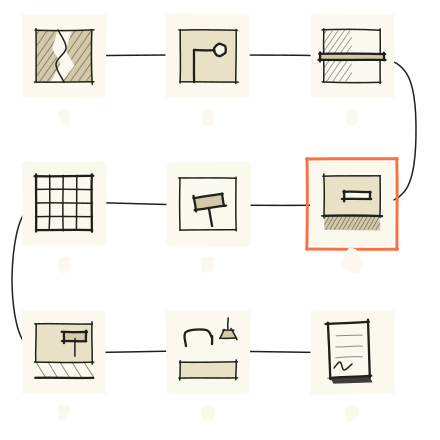
What comes first, wall plastering or floor screed?
Wall plastering comes first, and floor screed is poured afterwards.
Crews differ on when they run plumbing.
Some install water and heating pipes along with electrical wiring before plastering, while others lay pipes after plastering.
In either case, wall plastering is finished before the floor screed, and all floor pipes must be in place before the screed is poured.
Do not pour floor screed before plastering, because mortar falling from the walls will damage the fresh screed.
Floor and wall tiles are laid after the screed is done.
How long does floor screed take to dry?
Floor screed drying time depends on the layer thickness and room conditions, and usually takes at least 25-30 days in total for layers thicker than 4 cm.
- As a rule of thumb, allow about one week per 1 cm for layers up to 4 cm thick.
- Above 4 cm, each centimetre takes 1.5-2 weeks.
Readiness for final flooring is measured by residual moisture as well as days on the calendar.
The adhesive or flooring manufacturer sets the exact limit, with typical requirements shown below.
| Next flooring layer | Screed requirement |
|---|---|
| Tiles on cement-based adhesive | Screed age at least 28 days, moisture up to 4% |
| Laminate | Cement screed without additives: residual moisture below 2.0% (CM method), or below 1.8% with underfloor heating. |
| Tiles on factory rapid-drying mix | Tiles can be laid after 24 hours on a factory rapid-drying screed mix |
Lay vapour barrier film over the whole floor unless it is built into the underlay.
Always check the screed with a moisture meter before laying the final floor covering.
How do you check floor screed quality?
You check floor screed quality on site before making the final payment to the crew.
Print this stage's sheet from our stage acceptance checklist.
How do you check a floor screed crew and quote before agreeing?
You check a crew’s price by asking for a written itemised estimate where every line item has its own unit of measurement.
To get a free preliminary written estimate, send your floor area, photos of the floor and the building type. Say what is on the floor now, a bare concrete slab or an old screed, and whether you plan tiles, laminate or parquet.
Managing from abroad? Write in English for a free written preliminary estimate in 2 working days by email, WhatsApp, or Viber. How we run a job for owners abroad is on renovation for owners abroad.
Other renovation stages and prices
Request an estimate
Based on your floor area, building type, and photos, you get a free reply by email, WhatsApp, or Viber within 2 working days, with no obligation. Before the contract we see the flat, in person or on a video call, and fix the price.
Our schedule is booked until January 2027, so new renovations start from January. You still get your estimate now, and we agree the date to see the flat now.